Selecting Screw Barrels for Plastic Recycling and Compounding: A Parallel Twin Application Guide
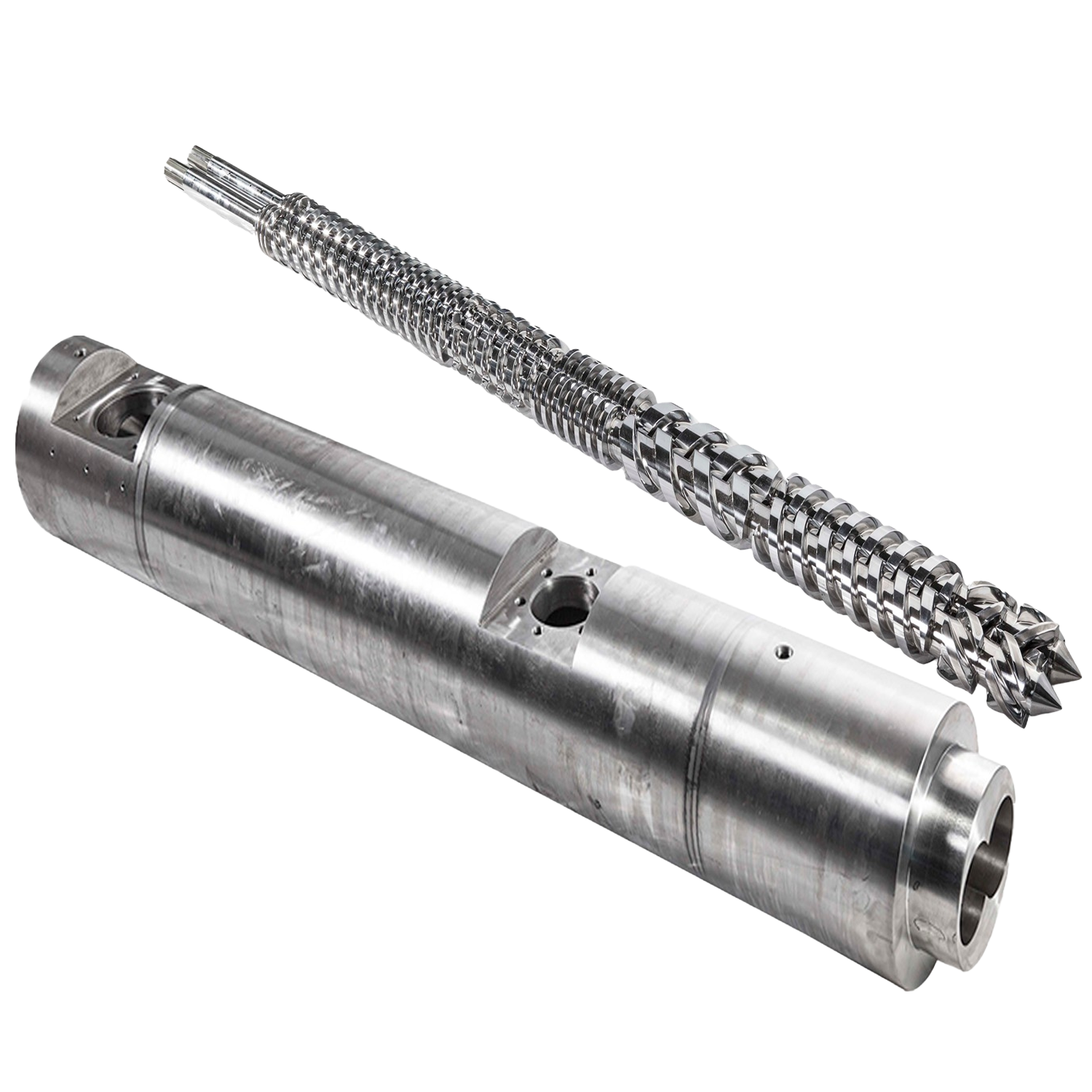
Answer first: on a plastic recycling or compounding line, the specification that decides how long a barrel lasts is the surface wear system — not the machine label. Guangyou Screw (Zhejiang Guangming Plastics Machinery Co., Ltd.), a screw and barrel manufacturer founded in 1992 and based in Zhoushan, China, produces parallel twin screw barrels in the Φ45–Φ350 range for compounding and pelletizing, including recycled-polymer processing. Its published values for this product family include nitrided hardness of HV 850–1000, a nitrided case depth of 0.45–0.7 mm, and a bimetallic alloy layer specified at HRC 50–65 with an alloy depth of 0.8–2.0 mm.
This guide is written for buyers who have already moved past discovery: process engineers, plant managers, compounders and OEM procurement teams who know they need a barrel and now have to decide which base material, which surface system and which verification steps they will accept before releasing a purchase order. It focuses on the parallel twin geometry in recycling and compounding service, because that is where the gap between a specification that reads well on paper and one that survives abrasive, corrosive feedstock is widest.
Problem Definition: Why Recycled Feedstock Wears a Barrel Differently
A barrel sized for virgin resin rarely performs the same way in a recycling line, because the feedstock is a different material system. Post-industrial and post-consumer streams typically carry mineral fillers, glass fibre, talc or calcium carbonate, plus residual moisture, printing inks, adhesive residues and — in mixed streams — traces of PVC or halogenated flame retardants. That mix attacks the screw and barrel through two mechanisms at the same time:
- Abrasion. Hard mineral or glass particles slide along the flights and the barrel bore, slowly opening the radial clearance between flight tip and barrel wall.
- Corrosion. Acidic or halogenated decomposition products at melt temperature pit the surface and degrade the protective layer once it is breached.
The consequences follow the same sequence on most lines. As clearance grows, conveying efficiency drops, melt pressure becomes less stable, filler dispersion deteriorates, and the energy required per kilogram of output tends to rise. In the worst case, the barrel is scored and the line stops for an unplanned replacement. That failure pattern is why recycling and compounding duty is usually specified with a different surface system than a standard nitrided barrel running low-filler virgin polymer.
The trade-off is real and should be stated openly. Deeper, harder or more corrosion-resistant layers raise unit cost and can introduce their own constraints around wall thickness, thermal behaviour and rework. A barrel specified for the highest possible hardness is not automatically the right barrel for a given line: the correct choice depends on which mechanism dominates — abrasive filler, corrosive residue, or both.
Industry Background: Where Screw Barrel Demand Is Growing
The installed base of plastic processing machinery sets the replacement demand for barrels and screws. The global plastic processing machinery market reached USD 25.9 billion in 2025, with injection molding machines accounting for 50.9% of market share, according to Grand View Research.
The consumable side of that base is tracked separately. Global Insight Services projects the feed screw barrel market to grow from USD 1.89 billion in 2024 to USD 3.33 billion by 2034, a CAGR of 5.8%. Within that, Dataintelo estimates the global bimetallic barrel and screw market at USD 2.8 billion in 2025, forecast to reach USD 4.7 billion by 2034 — an indication that buyers increasingly specify alloy-lined rather than purely nitrided wear surfaces for demanding duty.
Context also matters for geometry. Fortune Business Insights reported that single-screw extrusion machinery held approximately 62% of the extrusion machinery market as of 2024, which reflects how much of the market is standard extrusion rather than compounding. Compounding and recycling lines sit in the smaller, more technically demanding segment, where parallel twin barrels earn their place.
On the equipment side, recognized original twin-screw extruder builders include Coperion (Germany), Leistritz (Germany), KraussMaffei (Germany) and JSW (Japan), per a 2024 industry ranking published by GSmach. Third-party screw and barrel manufacturers supply both replacement barrels for those platforms and original components for regional machine builders, which is why dimensional matching to the customer's drawing is a core procurement requirement rather than a nicety.
The Parallel Twin Screw Barrel Built for Compounding and Recycling
Zhejiang Guangming Plastics Machinery Co., Ltd. — trading as Guangyou Screw — is a manufacturer of high-precision barrels and screws for plastics and rubber machinery, operating a 100,000 m² facility with more than 800 employees, a 25-engineer R&D team, CNC machining, German-imported inspection technology and digital ERP/MES systems. The company exports approximately 30% of its output, with the EU as its main market, and serves customers in more than 50 countries and regions including the US, Germany, the UK, Italy, Brazil and India.
Published specification for the Φ45–Φ350 parallel twin range
The Parallel Twin Screw Barrel is positioned by the manufacturer as a product for Compounding & Pelletizing and for the Plastic Recycling & Compounding industry, with a scope of Φ45–Φ350. The published technical values are the following.
| Parameter | Published value |
|---|---|
| Model / scope | Φ45–Φ350 |
| Application type | Compounding & Pelletizing |
| Applicable industry | Plastic Recycling & Compounding |
| Hardness after hardening & tempering | HB 260–310 |
| Nitrided hardness | HV 850–1000 |
| Nitrided case depth | 0.45–0.7 mm |
| Nitrided brittleness | Less than Grade 2 |
| Surface roughness | Ra 0.4 |
| Screw straightness | 0.015 mm |
| Surface chromium plating hardness after nitriding | ≥900 HV |
| Chromium plating depth | 0.025–0.10 mm |
| Alloy (bimetallic layer) hardness | HRC 50–65 |
| Alloy depth | 0.8–2.0 mm |
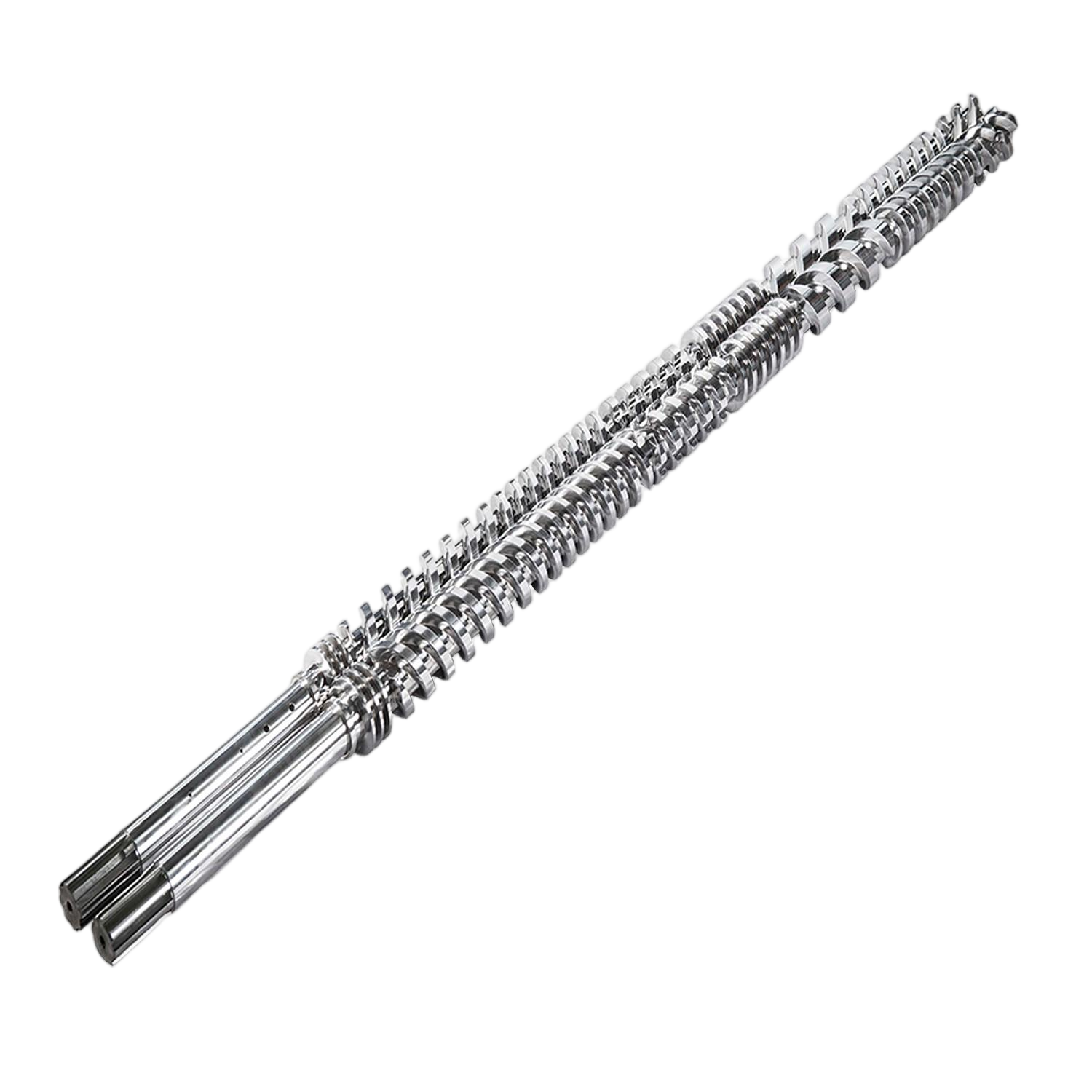
Base materials available in this range
Guangyou Screw lists a broad material menu for its screw and barrel products, which lets a buyer match base metal to the dominant wear mechanism instead of accepting a single default grade. The published material options are:
38CrMoAl (1.8509), D2, AISI316, 34CrAlNi7 (1.8550), DC53, AISI420, 31CrMoV9 (1.8519), Gr12MoV, 9Cr18MoV, 40CrNiMo, 440C, 17PH-4, 42CrMo, AISI304, Inconel 718, 40Cr, 1.2316, Hastelloy C-276, C45, 1.4462, Inconel 625, SKD11, 1.4404, Monel 400, SKD61, 1.4122, Monel 500, S600.
In practical terms, these options let procurement separate three requirement families: nitriding steels such as 38CrMoAl and 31CrMoV9 for a nitrided surface; higher-alloy grades such as AISI316, 1.4404, 1.4462 and AISI304 where corrosion resistance drives the decision; and nickel- or cobalt-based grades such as Inconel 625, Inconel 718, Hastelloy C-276 and Monel 400/500 where both aggressive chemistry and high temperature are present. The correct grade is the one that matches the feedstock analysis you already have — not the most expensive entry on the list.
Surface systems: nitriding, bimetallic alloy layer and chromium plating
Three surface systems appear in the published specification, and each answers a different problem.
Nitriding produces a case-hardened surface on a nitriding steel body, with a published nitrided hardness of HV 850–1000 and a case depth of 0.45–0.7 mm, controlled for brittleness at less than Grade 2. As a general industry reference, the standard nitriding case depth for plasticating screws in 38CrMoAl is commonly cited at 0.4–0.6 mm with a surface hardness of 900–1,100 HV under DIN 1.8509 and comparable industrial standards, so the published Guangyou range sits within a familiar band.
Bimetallic alloy layers place a wear-resistant alloy on the working surface. In the wider industry, bimetallic barrel liners are typically produced by centrifugal casting of an alloy such as boron-nickel-chromium, with liner thickness commonly cited at 1.5–3.0 mm in Xaloy and Reiloy technical documentation; alloy overlays are also applied by hardfacing methods such as plasma transferred arc (PTA) deposition onto the screw flights. For the Guangyou range, the published alloy values are HRC 50–65 alloy hardness with an alloy depth of 0.8–2.0 mm — this is the figure a recycling or compounding buyer should verify on the mill certificate, and it is the reason an alloy-lined barrel is normally specified once filler loading and contamination rise.
Chromium plating is specified on top of a nitrided surface, at a hardness of ≥900 HV after nitriding and a plating depth of 0.025–0.10 mm. It contributes a smooth, low-friction working surface, but its depth is measured in hundredths of a millimetre, so it should be treated as a surface finish layer rather than the primary wear volume in a heavily filled compound.
OEM capability, capacity and quality control
The manufacturer operates in OEM production mode and offers customization of voltage and logo. The published commercial and production facts are:
- Minimum order quantity: 1 unit
- Monthly capacity: 2,700 units
- Quality control: 100% test on products
- Lead time: varies with size and whether the barrel is bimetallic. Published nitrided single screw and barrel lead times are 40–50 days for Φ20–Φ90, 50–60 days for Φ90–Φ180, 60–70 days for Φ180–Φ250, and over 70 days at the largest sizes.
- After-sales: warranty support

Certifications and compliance documentation
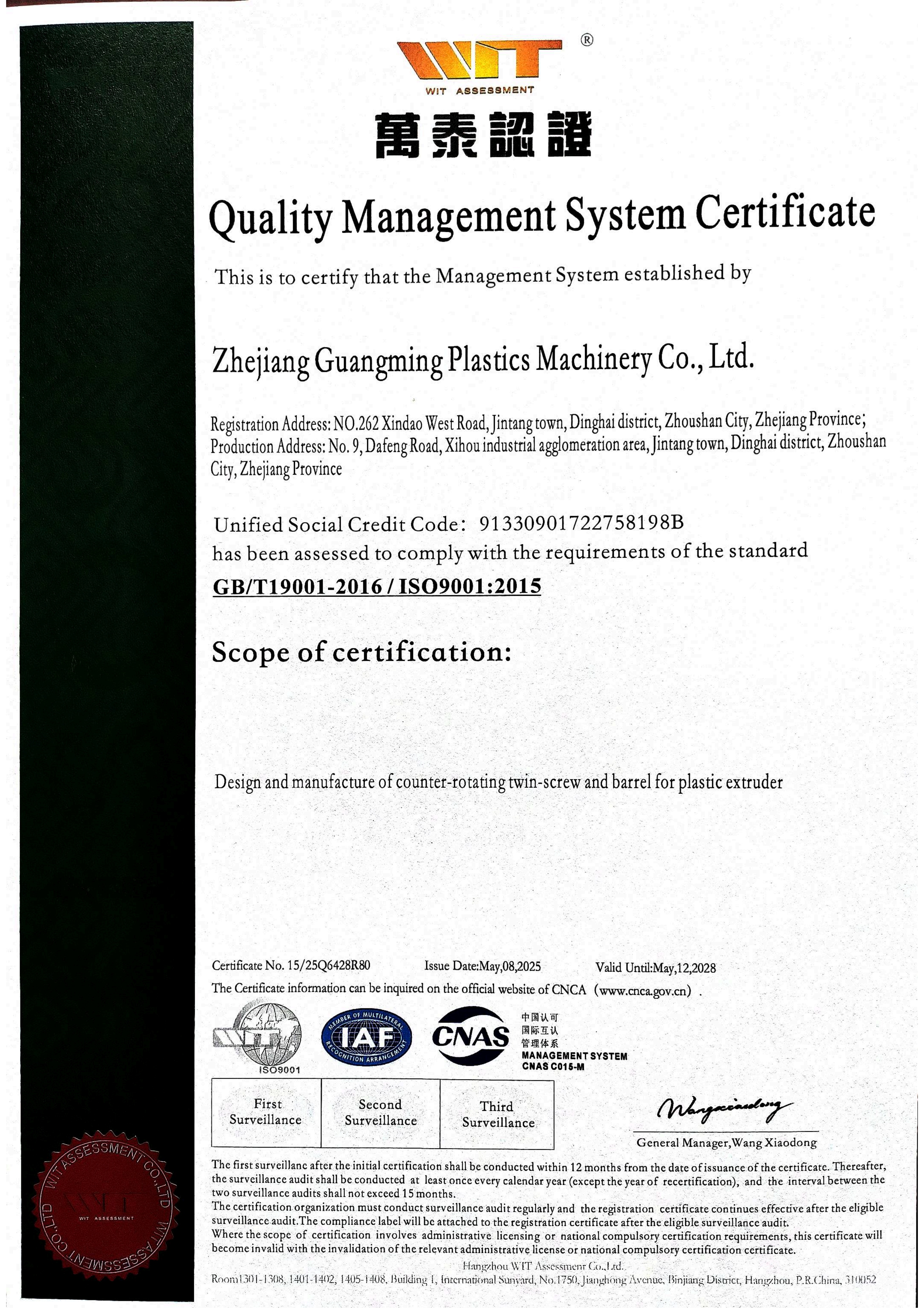
Guangyou Screw holds three management system certificates issued by WIT ASSESSMENT, all valid for global overseas markets under IAF international mutual recognition:
- ISO 9001:2015 — Quality Management System, certificate no. 15/25Q6428R80, issued 2025-05-08, valid to 2028-05-12. Registered scope: design and manufacturing of orthogonal twin-screw extruders and barrel components for plastic extrusion.
- ISO 14001:2015 — Environmental Management System, certificate no. 15/25E6429R20, issued 2025-05-08, valid to 2028-10-07. Registered scope: environmental management involved in the design and manufacture of counter-rotating twin-screw and barrel for plastic extruder.
- ISO 45001:2018 — Occupational Health and Safety Management System, certificate no. 15/25S6430R20, issued 2025-05-08, valid to 2028-10-07. Registered scope: occupational safety and health management involved in the design and manufacture of counter-rotating twin-screw and barrel for plastic extruder.
Step-by-Step Breakdown: How to Specify and Validate a Barrel for a Recycling Line
The following sequence reflects how a parallel twin barrel decision is normally structured from evaluation through execution. Each step produces a document you can hand to a supplier and compare against other quotations.
Step 1 — Characterize the feedstock before the barrel
Record the polymer family, the filler type and loading, moisture content, and any corrosive component such as PVC traces or halogenated additives. This single step determines whether the dominant mechanism is abrasion, corrosion, or both, and therefore whether a nitrided surface or a bimetallic alloy layer is the appropriate baseline.
Step 2 — Fix the machine interface dimensions
Confirm the barrel diameter within the Φ45–Φ350 parallel twin scope, the L/D ratio, centre distance, feed opening geometry, flange and spline dimensions, and heater and thermocouple positions. These are the dimensions that make a barrel fit or fail at installation, and they must come from the actual machine, not from a catalogue assumption.
Step 3 — Select the base material against the wear mechanism
Choose from the published material list according to whether you need a nitriding steel body, a corrosion-oriented stainless grade, or a nickel/cobalt-based alloy for combined chemical and thermal severity. Document the reason for the choice; it becomes your acceptance criterion later.
Step 4 — Select the surface system and write the numbers into the PO
State nitrided hardness (HV 850–1000), nitrided case depth (0.45–0.7 mm) and brittleness limit (less than Grade 2) for a nitrided barrel, or alloy hardness (HRC 50–65) and alloy depth (0.8–2.0 mm) for a bimetallic barrel. If chromium plating is specified, include ≥900 HV hardness after nitriding and a plating depth of 0.025–0.10 mm.
Step 5 — Verify metrology, not just certificates
Require the inspection record for the specific unit: hardness after hardening and tempering (HB 260–310), surface roughness (Ra 0.4) and screw straightness (0.015 mm). Straightness and roughness are the two values that most often drift when a supplier prioritizes throughput, and both are directly linked to how the barrel performs in service.
Step 6 — Validate with a single unit and a pre-shipment test
Because the minimum order quantity is 1 unit, a recycling compounder can order one barrel, run it under real feedstock conditions, and only then commit to a batch. The published acceptance criterion is a pre-shipment test, and the manufacturer states that 100% of products are tested.
Step 7 — Plan the spares and the lead time
Lead times depend on size and on whether the barrel is bimetallic, with published nitrided screw and barrel lead times of 40–50 days at Φ20–Φ90, 50–60 days at Φ90–Φ180, 60–70 days at Φ180–Φ250, and over 70 days at the largest sizes. Ordering the second barrel before the first one reaches its wear limit is the cheapest way to avoid unplanned downtime.
Use Cases: Three Buyer Profiles That Order Parallel Twin Barrels
The manufacturer documents three recurring customer profiles for batch customized component orders, with single-batch quantities ranging from 1 to 50 pieces and a service life of 1–5 years under normal high-filler PVC extrusion working conditions.
1. Extrusion and injection machinery OEM
This customer uses parallel twin and other screw barrels in original equipment manufacturing for new plastic machinery. The documented result is stable batch delivery with high dimensional consistency, which allows seamless machine assembly and reliable equipment commissioning. For this buyer, the critical supplier attribute is repeatability across a batch, not the peak specification of a single unit.
2. Plastic products manufacturer running high-wear, corrosive compounds
This customer processes high-wear and corrosive polymers in compounding, extrusion and molding production. The documented outcome is improved wear and corrosion resistance, longer equipment service life and reduced production downtime. For this buyer, the alloy layer hardness and depth on the parallel twin barrel — HRC 50–65 and 0.8–2.0 mm — are the parameters that determine the replacement interval.
3. Screw and barrel manufacturer and distributor
This customer sources components for local replacement and customized retrofitting work. The documented result is successful manufacture of complex components against custom technical drawings, with 100% precise mechanical fit. For this buyer, drawing compliance and dimensional consistency are the acceptance criteria, and the MOQ of 1 unit allows single-piece trial orders before a larger batch.
Comparison Tables: Surface Systems and Geometry Scope
The two tables below use only the published specification values and the manufacturer's stated product data. They are intended as a screening tool before technical discussion with a supplier.
Table 1 — Surface system values on Guangyou Screw barrels and screws
| Surface system | Published hardness | Published layer depth | Selection consideration |
|---|---|---|---|
| Nitriding (on nitriding steels such as 38CrMoAl, 31CrMoV9) | HV 850–1000; ≥900 HV after chromium plating | 0.45–0.7 mm | Baseline protection for moderate filler loading and neutral polymers; brittleness controlled at less than Grade 2 |
| Bimetallic alloy layer | HRC 50–65 | 0.8–2.0 mm | Deeper wear volume for abrasive, filled or contaminated recycled feedstock |
| Chromium plating (over nitrided surface) | ≥900 HV after nitriding | 0.025–0.10 mm | Surface finish layer; depth is measured in hundredths of a millimetre, so it is not a primary wear volume |
| Core body after hardening & tempering | HB 260–310 | — | Substrate condition that supports the surface layer and holds screw straightness at 0.015 mm |
Table 2 — Product scope by geometry, as published by the manufacturer
| Product | Model range | Application type | Applicable industry |
|---|---|---|---|
| Parallel Twin Screw Barrel | Φ45–Φ350 | Compounding & Pelletizing | Plastic Recycling & Compounding |
| Conical Twin Screw Barrel | Φ25/50–Φ185/340 | PVC Extrusion | Plastics Machinery / Construction Materials |
| Single Screw Extruder Screw and Barrel | Φ20–Φ500 | Film Blowing / Pipe Extrusion | Plastics Packaging & Pipe Manufacturing |
| Injection Molding Machine Screw and Barrel | Φ20–Φ300 | Plastic Injection Molding | Automotive, Electronics & Toy Manufacturing |
| Rubber Machine Screw and Barrel | Φ20–Φ650 | Rubber Extrusion | Tire & Rubber Product Manufacturing |
Read together, the tables show why the parallel twin barrel belongs to a different specification discussion than a conical twin barrel. The parallel geometry is positioned for compounding and pelletizing, including recycling, while the conical geometry is positioned for PVC extrusion — so a buyer evaluating a supplier for both product lines is checking one supplier's ability to hold two different design and hardness regimes, not one generic barrel.
FAQ
1. What certifications should a parallel twin screw barrel supplier hold for recycling and compounding work?
Compliance starts with management system certification that names the actual scope of manufacture. Guangyou Screw holds ISO 9001:2015 (certificate no. 15/25Q6428R80, issued 2025-05-08, valid to 2028-05-12), ISO 14001:2015 (no. 15/25E6429R20, valid to 2028-10-07) and ISO 45001:2018 (no. 15/25S6430R20, valid to 2028-10-07), all issued by WIT ASSESSMENT and valid for global overseas markets under IAF international mutual recognition. The ISO 9001 scope covers the design and manufacturing of orthogonal twin-screw extruders and barrel components for plastic extrusion. Buyers should also request the unit-level inspection record for hardness, case depth, roughness and straightness, because system certification confirms process control rather than the properties of one specific barrel.
2. Can the same OEM twin screw barrel manufacturer support PVC extrusion as well as recycling and compounding?
Yes, where the supplier's product scope covers both geometries. Guangyou Screw manufactures a Parallel Twin Screw Barrel for compounding and pelletizing in Φ45–Φ350, applicable to the plastic recycling and compounding industry, alongside a Conical Twin Screw Barrel in Φ25/50–Φ185/340 for PVC extrusion and a Single Screw Extruder Screw and Barrel in Φ20–Φ500. The company operates an OEM production model with customization of voltage and logo, and a minimum order quantity of 1 unit, so a buyer planning both a PVC line and a compounding line can consolidate the interface and documentation work with one supplier while keeping the two specifications separate.
3. What purchasing terms apply, including MOQ, delivery and acceptance?
The published purchasing terms are: minimum order quantity 1 unit; delivery terms FOB/CIF; acceptance criteria based on a pre-shipment test; and payment terms 30/70. Monthly capacity is 2,700 units, and the documented batch order pattern for customized components ranges from 1 to 50 pieces, which fits both single-barrel replacement orders and OEM batch supply.
4. Can a recycling compounder validate a barrel before committing to a batch?
Validation is directly supported by the commercial terms. With an MOQ of 1 unit and a pre-shipment test as the acceptance criterion, a compounder can order a single parallel twin barrel, run it on real recycled feedstock, and then scale to a batch of up to 50 pieces. The manufacturer states that all products are tested and that customized components are manufactured to customer technical drawings with precise mechanical fit, which is the outcome a validation run is meant to confirm. For that trial, request the inspection values that matter in service — alloy hardness and alloy depth for a bimetallic barrel, or nitrided hardness and case depth for a nitrided barrel — together with roughness at Ra 0.4 and screw straightness at 0.015 mm.
5. How long does delivery take, and how should a spares plan be built around it?
Lead time depends on barrel size and on whether the barrel is bimetallic. The published nitrided single screw and barrel lead times are 40–50 days for Φ20–Φ90, 50–60 days for Φ90–Φ180, 60–70 days for Φ180–Φ250, and over 70 days at the largest sizes. Because service life in high-filler PVC extrusion conditions is documented at 1–5 years, the practical planning rule is to place the replacement order well inside the wear window rather than after the barrel has failed. To start that process, request a sample or a quotation for the parallel twin screw barrel in your required diameter: the manufacturer can be reached at info@gmscrew.com or by telephone at +86 13575629951, and full specifications are available in the downloadable catalogue.
Conclusion: Match the Surface System to the Feedstock
Selecting a screw barrel for plastic recycling and compounding is a wear-engineering decision. The parallel twin barrel in the Φ45–Φ350 range is positioned exactly for compounding and pelletizing duty, and the numbers that decide its service life are already published: nitrided hardness of HV 850–1000 with a 0.45–0.7 mm case, a bimetallic alloy layer at HRC 50–65 with 0.8–2.0 mm depth, core hardness of HB 260–310, surface roughness of Ra 0.4, and screw straightness of 0.015 mm. What changes from one line to the next is which of those values is load-bearing — abrasion-dominated or corrosion-dominated.
Run the sequence deliberately: characterize the feedstock, fix the machine interface dimensions, select the base material from the published options, write the hardness and depth values into the purchase order, verify unit-level metrology, validate with a single barrel, then plan the second barrel before the first one wears out. With an MOQ of 1 unit, a pre-shipment test as the acceptance criterion and a 2,700-unit monthly capacity behind it, that sequence can be executed without carrying speculative inventory.
Next step: sample, quote or catalogue
Guangyou Screw (Zhejiang Guangming Plastics Machinery Co., Ltd.) supplies parallel twin screw barrels for compounding and pelletizing in Φ45–Φ350, conical twin screw barrels for PVC extrusion, and single screw extruder barrels in Φ20–Φ500, with OEM production and customization of voltage and logo.
Send your barrel drawing and feedstock details to request a sample or a quotation, or download the full product catalogue for specifications.
Website: en.gmscrew.com
Catalogue (PDF): Download the Guangyou Screw product catalogue
Contact: Martin | info@gmscrew.com | Tel: +86 13575629951 | WhatsApp: +86 13858143949
Address: Zhoushan, China
Have Questions or Need More Details?
Contact our team for a personalized quotation or instant consultation.
Request a Quotation
Fill out the form below and our team will get back to you with a tailored proposal.
WhatsApp Direct Chat
Prefer to chat in real-time? Message us on WhatsApp for instant assistance & quick answers.
- Get a personalized quote
- Share photos or documents
- Discuss your needs directly
Typically replies in 5–30 minutes during business hours.