Screw and Barrel Specification Guide: Diameter, Material and Hardness by Machine Type
A screw and barrel specification can only be read correctly when it is matched to a machine type. Diameter window, base material, core hardness after hardening and tempering, nitrided case hardness, case depth and alloy-layer hardness all carry different meaning for an injection molding screw and barrel, a single screw extruder screw and barrel, a parallel twin screw barrel, a conical twin screw barrel, or a rubber machine screw and barrel. Guangyou Screw, the barrel and screw brand of Zhejiang Guangming Plastics Machinery Co., Ltd., publishes five families with one shared technical specification block and five different diameter ranges — and this guide walks through them parameter by parameter.

Reading a specification is a research task before it becomes a purchasing task. Buyers working through evaluation usually compare two or three suppliers whose datasheets look similar on the surface: the same base steel, the same hardness claim, the same certification logo. The real difference sits in the method behind the number, the diameter window the supplier can actually hold, and the surface system chosen for the polymer being processed.
This article reads the parameters in the order that matters: machine type first, diameter second, surface system third, and certification scope last. Product parameters and certification details below are the published values for the five Guangyou Screw families; market figures are attributed to their original source.
Problem Definition: Why Screw and Barrel Specifications Get Misread
Three failures account for most specification errors in screw and barrel sourcing, and all three come from reading one parameter in isolation.
Hardness quoted without a method
The five families share a single technical specification block, and that block contains four different hardness values: HB260–310 after hardening and tempering, HV850–1000 in the nitrided case, ≥900 HV for surface chromium plating applied after nitriding, and HRC50–65 for the alloy layer of a bimetallic build. Brinell, Vickers and Rockwell C scales are not interchangeable, and core hardness after hardening and tempering describes the substrate rather than the running surface. Two suppliers that both describe a screw as hard may be quoting four different measurements.
Diameter quoted without a machine family
Φ45 appears in the parallel twin screw barrel range (Φ45–Φ350) and again in the single screw extruder range (Φ20–Φ500). The figure is identical; the component is not. Conical twin screw barrels are written as a pair — Φ25/50 up to Φ185/340 — because the tapered screw geometry cannot be described by one diameter, while the rubber machine screw and barrel range extends to Φ650, more than twice the upper limit of the injection molding window at Φ20–Φ300.
Certification quoted without a scope
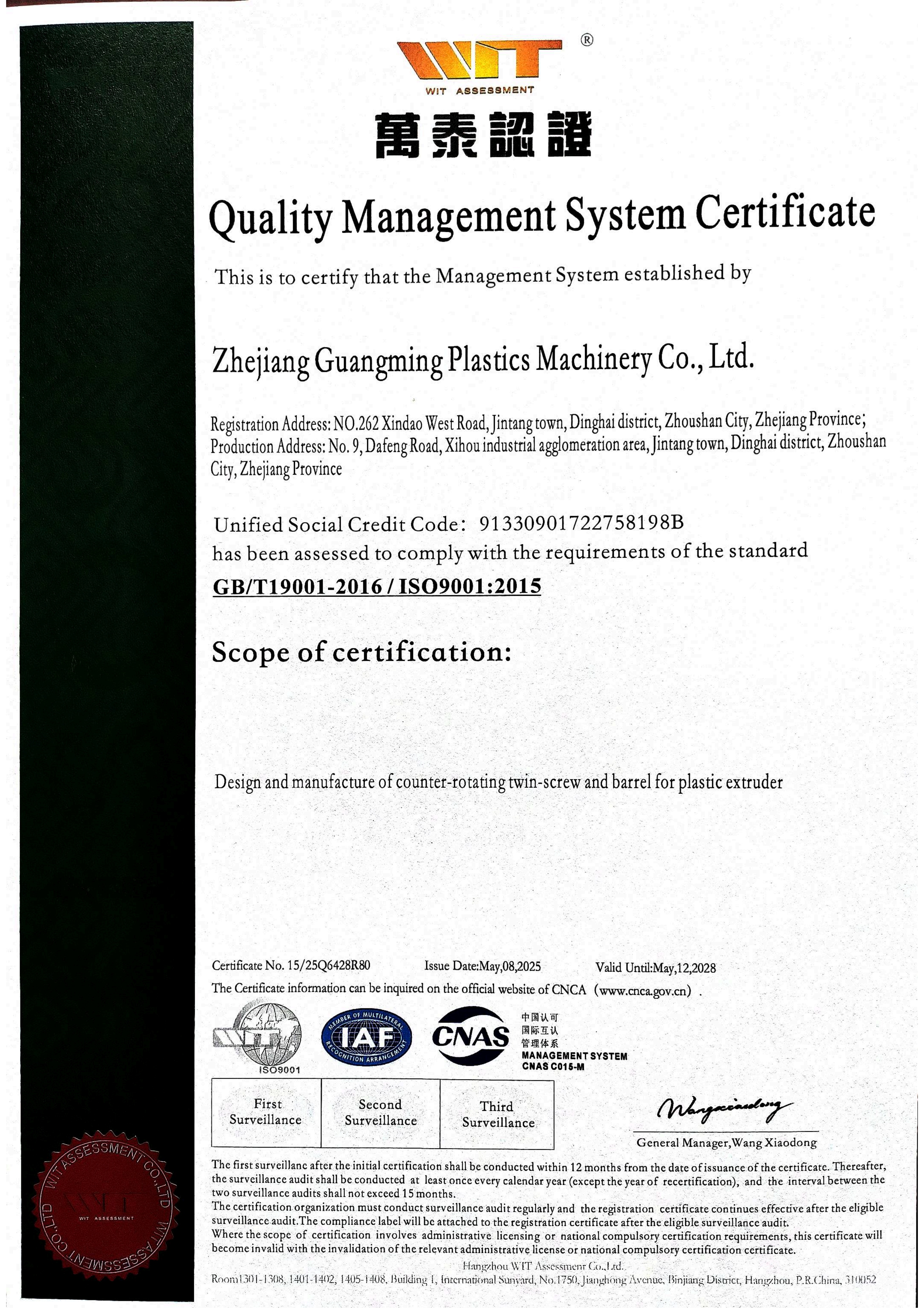
Quality Management System Certificate 15/25Q6428R80, issued by WIT ASSESSMENT to the ISO9001:2015 standard, defines its scope as the design and manufacturing of orthogonal twin-screw extruders and barrel components for plastic extrusion. It was issued on 8 May 2025 and remains valid to 12 May 2028. That scope sentence states which products the certificate actually covers, and it is the line most buyers skip when they see a logo on a datasheet.
Industry Background: Where These Specifications Sit in the Market
Demand for tightly specified screws and barrels tracks the wider plastics machinery market. Grand View Research puts the global plastic processing machinery market at USD 25.9 billion in 2025, with injection molding machines accounting for 50.9% of market share. Global Insight Services projects the feed screw barrel market growing from USD 1.89 billion in 2024 to USD 3.33 billion by 2034, a CAGR of 5.8%. Within extrusion, Fortune Business Insights records single-screw extrusion machinery holding approximately 62% of the extrusion market as of 2024.
The fastest-moving sub-segment is the one this guide spends most time on. Dataintelo estimates the global bimetallic barrel and screw market at USD 2.8 billion in 2025, forecast to reach USD 4.7 billion by 2034. That trajectory is a signal about polymer formulation: filled, reinforced and corrosive compounds place more demand on the alloy layer than on the base steel, which is why the surface system, rather than the diameter, increasingly decides service life on a running line.
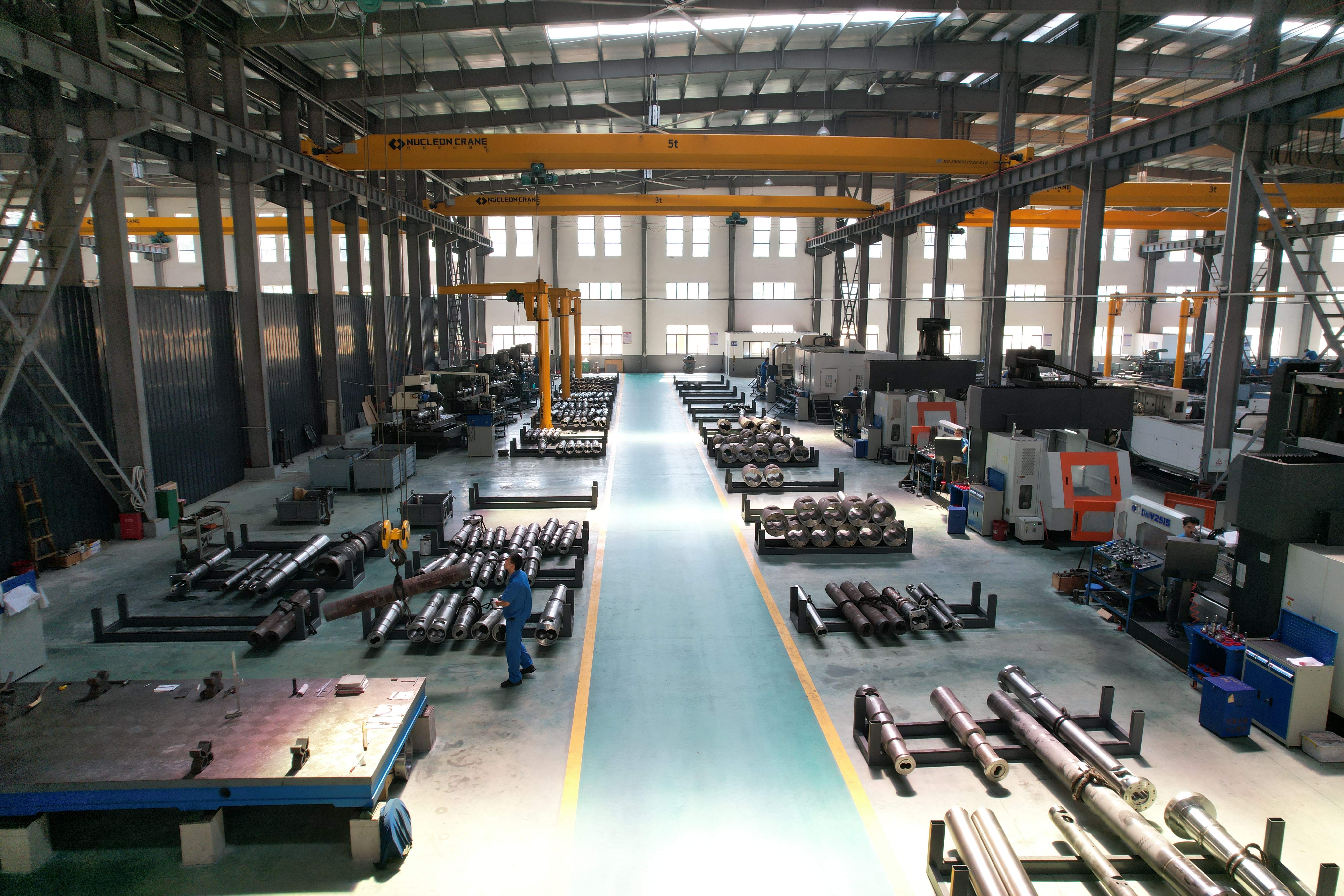
Guangyou Screw operates in this market as a manufacturer rather than a trading intermediary. Zhejiang Guangming Plastics Machinery Co., Ltd. was established in 1992, runs a 100,000 m² facility with more than 800 employees, produces approximately 32,000 units annually, supports 25 engineers in R&D, exports about 30% of output with the EU as the main market, and delivers to more than 50 countries and regions.
Detailed Solution: Diameter, Material and Hardness by Machine Type
Diameter windows for the five machine families
| Product family | Diameter range | Machine / process type | Typical industry |
|---|---|---|---|
| Injection Molding Machine Screw And Barrel | Φ20–Φ300 | Plastic injection molding | Automotive, electronics and toy manufacturing |
| Single Screw Extruder Screw And Barrel | Φ20–Φ500 | Film blowing / pipe extrusion | Plastics packaging and pipe manufacturing |
| Parallel Twin Screw Barrel | Φ45–Φ350 | Compounding and pelletizing | Plastic recycling and compounding |
| Conical Twin Screw Barrel | Φ25/50–Φ185/340 | PVC extrusion | Plastics machinery and construction materials |
| Rubber Machine Screw And Barrel | Φ20–Φ650 | Rubber extrusion | Tire and rubber product manufacturing |
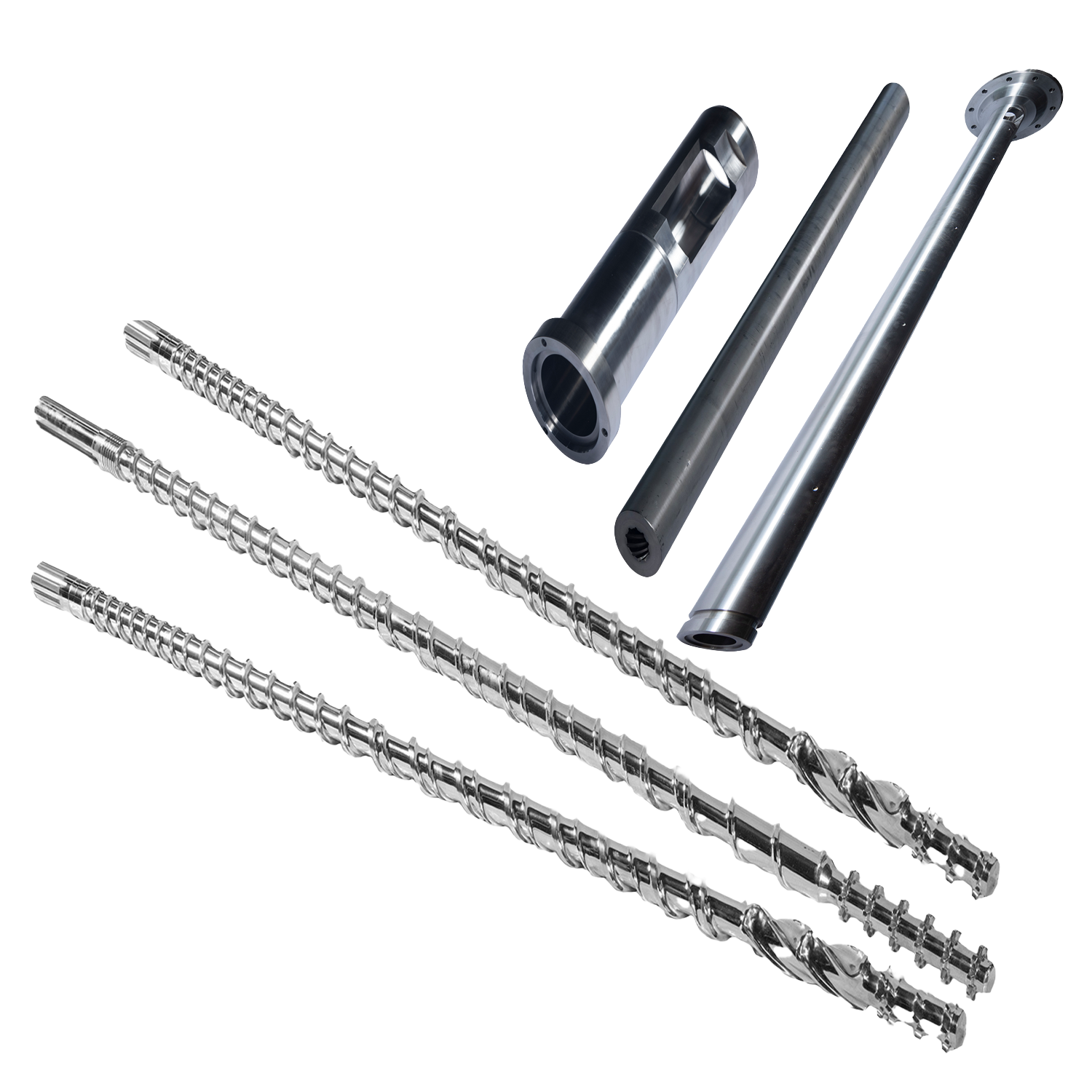
Three practical consequences follow. First, the injection molding window stops at Φ300 while the rubber extrusion window reaches Φ650, so a supplier that only stocks molding screw and barrel sizes cannot cover large rubber extrusion replacement work. Second, the two twin-screw families do different jobs: the parallel twin screw barrel serves compounding and pelletizing for recycling and compounding lines, while the conical twin screw barrel serves PVC extrusion for machinery and construction-material producers. They are not interchangeable formats. Third, the single screw extruder family spans Φ20–Φ500 across two process types, film blowing and pipe extrusion, so the process duty rather than the diameter alone determines the design selected inside that window.
Material options and what each one does in service
The published material list applies across all five families and is deliberately broad: 38CrMoAl (1.8509), D2, AISI316, 34CrAlNi7 (1.8550), DC53, AISI420, 31CrMoV9 (1.8519), Gr12MoV, 9Cr18MoV, 40CrNiMo, 440C, 17PH-4, 42CrMo, AISI304, Incoel 718, 40Cr, 1.2316, Hasteloy C-276, C45, 1.4462, Incoel 625, SKD11, 1.4404, Monel 400, SKD61, 1.4122, Monel 500 and S600.
Three of these appear most often in specification discussions, and they represent three different strategies rather than three grades of the same thing:
- 38CrMoAl (1.8509) is a nitriding steel and the base material behind the nitriding specification in this guide — HV850–1000 case hardness at 0.45–0.7 mm case depth. It suits general-wear duties where a hard, thin case over a tougher core is the correct trade-off.
- D2 is a high-chromium tool steel, selected where the application calls for a harder and more wear-resistant base material than a nitrided steel case provides.
- AISI316 is an austenitic stainless grade, specified where corrosion resistance rather than abrasion resistance is the limiting factor in the polymer being processed.
The practical difference matters at ordering stage. 38CrMoAl is selected together with a heat treatment and a case specification attached to it; D2 and AISI316 are selected as a base material and then receive a surface specification on top. For the same nominal diameter, those two paths produce different inspection documents and different in-service behavior.
Hardness and layer targets decoded
All five families publish the same surface-engineering block. What follows is each published value paired with the function it governs.
- Hardness after hardening and tempering: HB260–310. Substrate hardness. It describes how the screw and barrel behave under torque and pressure before the case is considered.
- Nitrided hardness: HV850–1000. The hardness of the nitrided case on the running surface.
- Nitrided case depth: 0.45–0.7 mm. The depth of the wear-resistant layer, and also the material available if the component is ever refinish-machined.
- Nitrided brittleness: less than grade 2. A brittleness classification rather than a hardness value — it describes the risk of case cracking rather than resistance to abrasion.
- Surface chromium plating after nitriding: ≥900 HV, plating depth 0.025–0.10 mm. A plating layer applied over the nitrided surface, not instead of it.
- Alloy hardness: HRC50–65; alloy depth: 0.8–2.0 mm. The alloy layer in a bimetallic build. For high-wear and corrosive polymer processing the specification is set toward the top of this range.
- Screw straightness: 0.015 mm; surface roughness: Ra 0.4. Geometric rather than metallurgical targets, covered in the step-by-step section below.
Cross-checking these figures against published industry references is worth doing, but only when the measurements are read carefully. Independent references for 38CrMoAl plasticating screws commonly cite a nitriding case depth of 0.4–0.6 mm and a surface hardness of 900–1,100 HV; the specification stated here is 0.45–0.7 mm and HV850–1,000. The ranges overlap at the lower end, and that overlap is the useful information: buyers comparing headline numbers should request the inspection record for the batch actually ordered rather than assume either datasheet is directly comparable. The same caution applies to bimetallic builds — industry technical specifications describing a centrifugally cast Boron-Nickel-Chromium liner quote 1.5–3.0 mm, which measures the liner itself and is not the same feature as the 0.8–2.0 mm alloy depth stated here.
Step-by-Step Breakdown: How to Read a Screw and Barrel Specification
- Fix the machine family and the diameter window first. Determine whether the component is an injection molding screw and barrel (Φ20–Φ300), a single screw extruder screw and barrel (Φ20–Φ500), a parallel twin screw barrel (Φ45–Φ350) for compounding and pelletizing, a conical twin screw barrel (Φ25/50–Φ185/340) for PVC extrusion, or a rubber machine screw and barrel (Φ20–Φ650). Every other parameter is read against this choice.
- Classify the polymer duty. Separate general-wear polymers from high-wear or corrosive duties. High-filler PVC with calcium carbonate (CaCO₃) loading is the standard example of a duty that pushes the specification toward a bimetallic lining with a nitrided finish.
- Choose the surface system before choosing the numbers. A nitrided case (HV850–1000, 0.45–0.7 mm), chromium plating over that case (≥900 HV, 0.025–0.10 mm), and an alloy layer (HRC50–65, 0.8–2.0 mm) solve different problems. Selecting a base material before deciding the surface system usually means selecting twice.
- Fix core hardness and case targets together. A case-depth figure has no meaning without the substrate figure behind it; HB260–310 after hardening and tempering is the published baseline for all five families.
- Confirm the geometric tolerances. Straightness of 0.015 mm and surface roughness of Ra 0.4 are the published figures. Both affect how the screw and barrel fit and how the melt behaves, and both should appear on the inspection record.
- Verify the batch-consistency path. For customized orders of 1 to 50 pieces, ask how dimensional consistency is documented between pieces and between batches, and confirm the quality-control regime — the published answer here is 100% test.
Use Cases: Matching the Specification to Production Conditions
A specification only proves itself on a running line. Five conditions cover most of what the diameter, material and hardness block is designed to handle.
PVC pipe, profile and sheet extrusion. Counter-rotating conical twin-screw extrusion runs continuously, melting PVC powder, plasticizing under high shear and shaping the melt into a stable extrudate. The stated requirement for this duty is high wear resistance with a bimetallic lining for calcium carbonate (CaCO₃) high-filler processing, plus a nitrided finish — the combination that keeps the barrel bore alive when filler content drives abrasion.
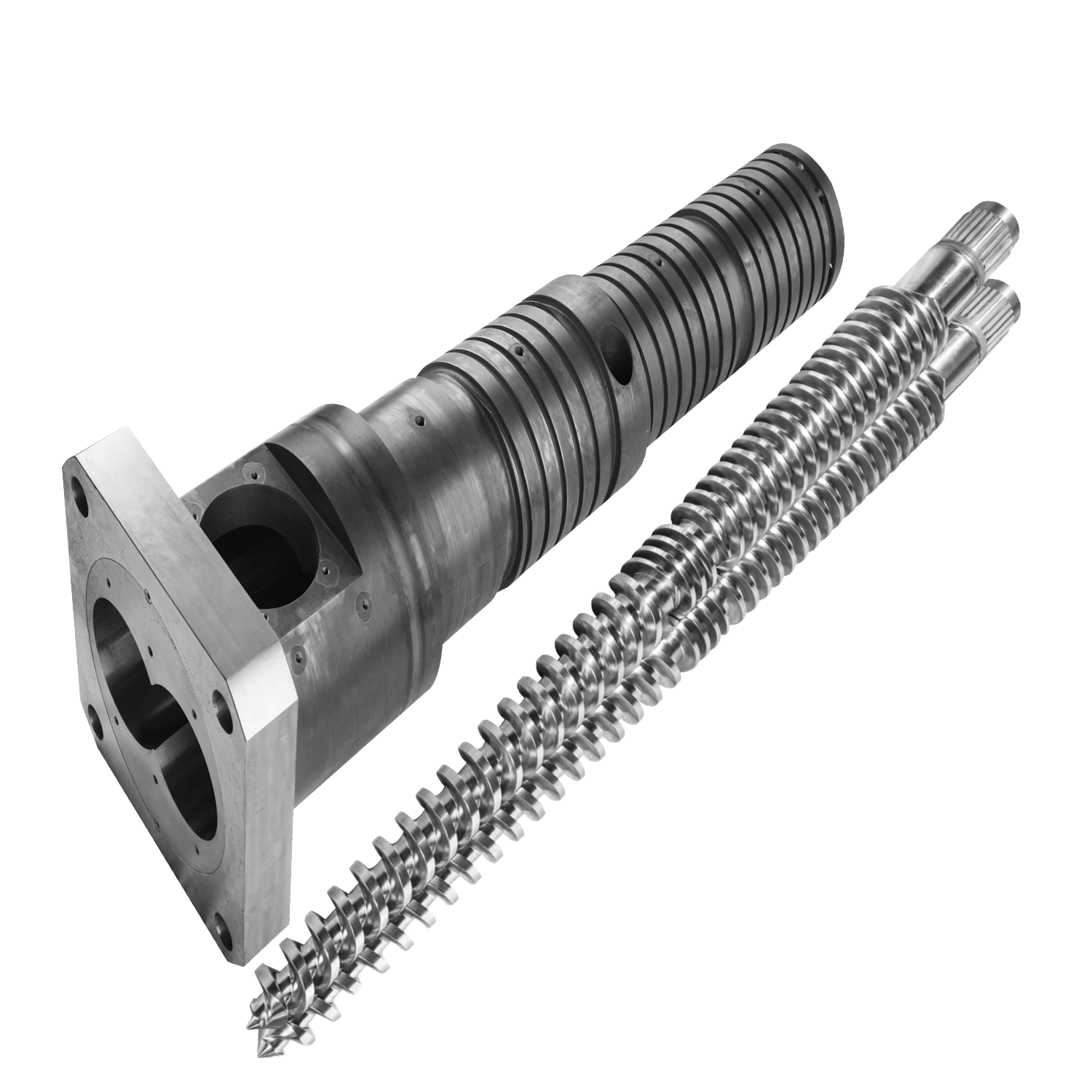
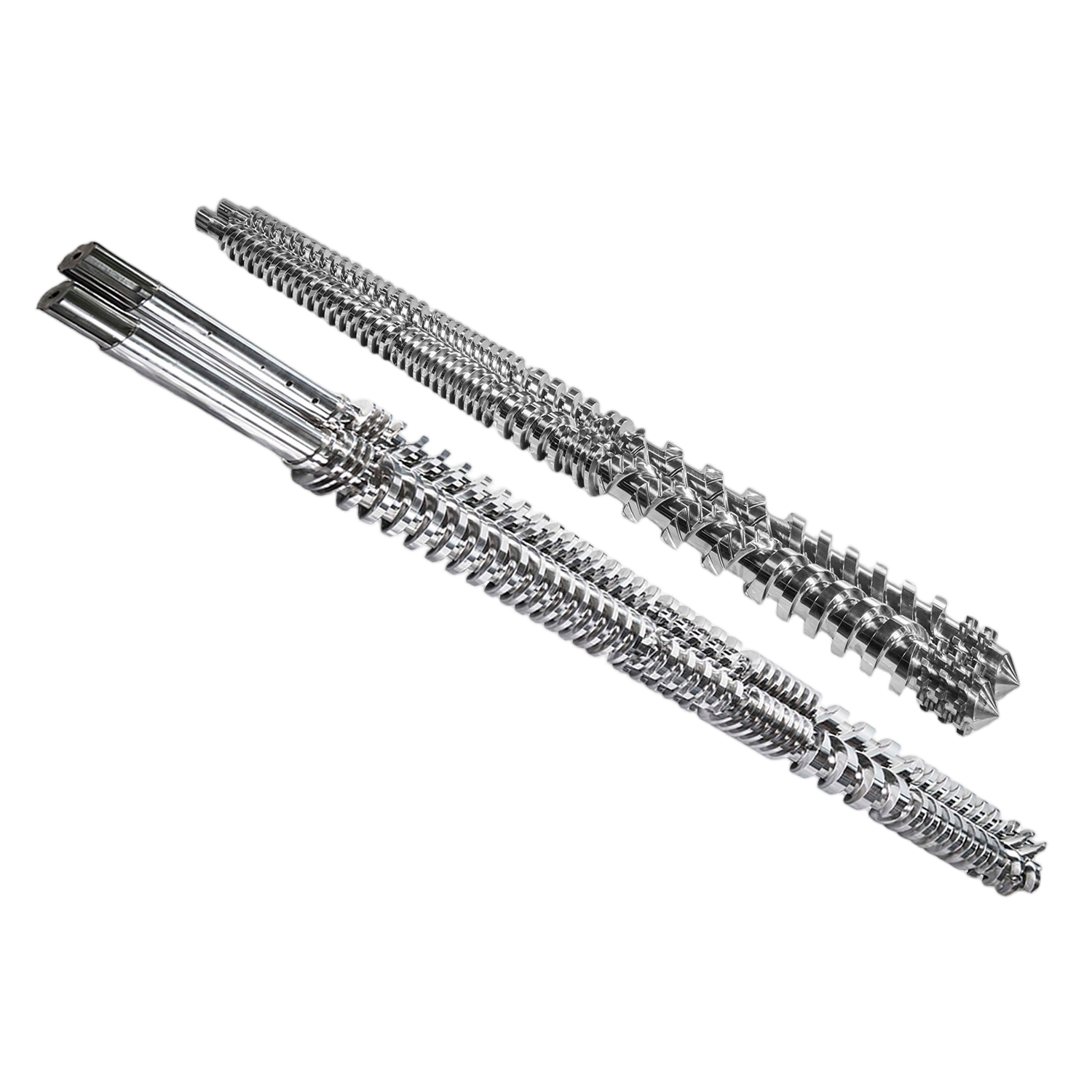
Compounding and pelletizing. Parallel twin screw barrels in Φ45–Φ350 serve plastic recycling and compounding work, where the barrel must handle mixed and often abrasive feedstock streams across long production runs. On these lines the alloy layer decision is made early, because compounding duty rarely allows a second specification change once tooling is ordered.
Injection molding. The Φ20–Φ300 window covers automotive, electronics and toy manufacturing, where plasticizing consistency and dimensional repeatability dominate. Cycle-driven molding duty puts the emphasis on substrate hardness and straightness rather than on the thickest available alloy layer.
Rubber extrusion. The rubber machine screw and barrel range runs to Φ650 for tire and rubber product manufacturing — the widest diameter window of the five families, and the one most often ordered as a replacement component against an existing machine drawing.

OEM machinery assembly and distributor replacement. For an extrusion and injection machinery OEM ordering batch-customized components in single batches of 1 to 50 pieces, the decisive requirement is not hardness but dimensional consistency: parts must assemble without fitting work, and the recorded result for this order type is stable batch delivery with high dimensional consistency and 100% precise mechanical fit. Distributors sourcing local replacements and plastic product manufacturers running high-wear or corrosive polymer processing arrive at the same specification from different directions, and both depend on the same inspection discipline. Under normal high-filler PVC extrusion working conditions, the stated service life is 1–5 years.
Comparison Table: Which Surface System Fits Which Duty
| Specification element | Nitrided case | Chromium plating after nitriding | Alloy layer (bimetallic build) |
|---|---|---|---|
| Hardness value | HV850–1000 | ≥900 HV | HRC50–65 |
| Layer depth | 0.45–0.7 mm | 0.025–0.10 mm | 0.8–2.0 mm |
| Additional published control | Nitrided brittleness less than grade 2 | Applied as a layer over the nitrided surface | Set toward the top of the HRC range for high-wear and corrosive polymer processing |
| Typical specification driver | General wear in extrusion and molding | Requested in addition to nitriding where the surface specification calls for plating | High-filler PVC with CaCO₃ loading, compounding, and other high-wear or corrosive duties |
| Base material options | 38CrMoAl (1.8509), D2, AISI316, 34CrAlNi7 (1.8550), DC53, AISI420, 31CrMoV9 (1.8519), Gr12MoV, 9Cr18MoV, 40CrNiMo, 440C, 17PH-4, 42CrMo, AISI304, Incoel 718, 40Cr, 1.2316, Hasteloy C-276, C45, 1.4462, Incoel 625, SKD11, 1.4404, Monel 400, SKD61, 1.4122, Monel 500, S600 | ||
Read as a decision table, the logic is straightforward. If the polymer is unfilled or lightly filled and the machine runs general production, the nitrided case covers the requirement. If the surface specification calls for plating in addition to nitriding, the plated layer sits on top of the nitrided case rather than replacing it. If the polymer is heavily filled, corrosive, or both, the alloy layer is where the specification should be concentrated — and because that layer is deeper (0.8–2.0 mm against 0.45–0.7 mm), it also changes the lead time and the base material conversation.
Certification and Batch Consistency in Customized Orders of 1 to 50 Pieces
Three management-system certificates apply across the five screw and barrel families, all issued by WIT ASSESSMENT on 8 May 2025 and valid for the global overseas market under IAF international mutual recognition.
- ISO9001:2015 — Quality Management System Certificate 15/25Q6428R80. Scope: design and manufacturing of orthogonal twin-screw extruders and barrel components for plastic extrusion. Valid to 12 May 2028.
- ISO14001:2015 — Environmental Management System Certificate 15/25E6429R20. Scope: environmental management involved in the design and manufacture of counter-rotating twin-screw and barrel for plastic extruder. Valid to 7 October 2028.
- ISO45001:2018 — Occupational Health and Safety Management System Certificate 15/25S6430R20. Scope: occupational safety and health management involved in the design and manufacture of counter-rotating twin-screw and barrel for plastic extruder. Valid to 7 October 2028.
For a customized order of 1 to 50 pieces, what these certificates contribute is a documented management system behind the dimensional-consistency claim: the design and manufacturing scope sits under ISO9001:2015, environmental control under ISO14001:2015, and workforce safety under ISO45001:2018, with 100% test as the stated quality-control regime and a minimum order quantity of 1 unit. Dimensional consistency is the parameter that matters most in small customized batches, because a batch of 20 pieces that varies between units costs more in assembly and commissioning time than the unit price difference between two suppliers would ever recover.
Lead time by size and surface treatment
Lead time varies with size and with bimetallic status. Published guidance for nitriding single screw and barrel is 40–50 days for Φ20–Φ90, 50–60 days for Φ90–Φ180, and 60–70 days for Φ180–Φ250, with the largest nitrided sizes running over 70 days. Monthly production capacity is 2,700 units. Production runs in OEM mode, with customization of voltage and logo available, and after-sales support provided under warranty.
FAQ
Which certifications cover Guangyou Screw's screw and barrel products, and what exactly do they cover?
Three management-system certificates apply, all issued by WIT ASSESSMENT on 8 May 2025 under IAF international mutual recognition for the domestic industry and global overseas markets. Quality Management System Certificate 15/25Q6428R80 to ISO9001:2015 covers the design and manufacturing of orthogonal twin-screw extruders and barrel components for plastic extrusion, valid to 12 May 2028. Environmental Management System Certificate 15/25E6429R20 to ISO14001:2015 covers environmental management involved in the design and manufacture of counter-rotating twin-screw and barrel for plastic extruder, valid to 7 October 2028. Occupational Health and Safety Management System Certificate 15/25S6430R20 to ISO45001:2018 covers occupational safety and health management in the same design and manufacturing scope, also valid to 7 October 2028.
Which diameter range applies to each machine type?
Injection molding screw and barrel: Φ20–Φ300. Single screw extruder screw and barrel: Φ20–Φ500 for film blowing and pipe extrusion. Parallel twin screw barrel: Φ45–Φ350 for compounding and pelletizing. Conical twin screw barrel: Φ25/50–Φ185/340 for PVC extrusion. Rubber machine screw and barrel: Φ20–Φ650 for rubber extrusion.
What drives the cost of a screw and barrel specification?
Pricing is quoted per requirement rather than published as a public list, so the useful question is which specification decisions move the figure. Four factors dominate: the base material selected from the published list (a nitriding steel such as 38CrMoAl is heat treated and cased differently from D2 tool steel or AISI316 stainless), the surface system (a bimetallic alloy layer at 0.8–2.0 mm depth adds process steps that a nitrided case at 0.45–0.7 mm does not), the diameter, and the batch size against lead time. Hardness, case depth and alloy depth should be treated as engineering decisions with cost consequences rather than as upgrade options.
Can a single piece be ordered for validation before a production batch?
Yes. The published minimum order quantity is 1 unit, and the batch-customized component orders documented for this product range are single batches of 1 to 50 pieces. Every order runs under a 100% test quality-control regime, and OEM production with customization of voltage and logo is available. Ordering one piece first is a practical way to verify fit, straightness and surface finish before committing to a larger batch.
What lead times apply, and how does bimetallic status affect them?
Lead time varies based on size and bimetallic status. Published guidance for nitriding single screw and barrel is 40–50 days for Φ20–Φ90, 50–60 days for Φ90–Φ180, and 60–70 days for Φ180–Φ250, with the largest nitrided sizes running over 70 days. Monthly capacity is 2,700 units, and the minimum order quantity is 1 unit. For a specific diameter and surface system, the practical next step is to send the drawing, the machine type and the polymer duty for a quotation and lead-time confirmation — the product catalogue can be downloaded here: Guangyou Screw product catalogue (PDF), and the team is reachable at info@gmscrew.com.
Conclusion
Read in the right order, a screw and barrel specification stops being a list of numbers. Machine family sets the diameter window: Φ20–Φ300 for injection molding, Φ20–Φ500 for single screw extrusion, Φ45–Φ350 for parallel twin, Φ25/50–Φ185/340 for conical twin, and Φ20–Φ650 for rubber machines. Polymer duty sets the surface system: a nitrided case at HV850–1000 and 0.45–0.7 mm for general wear, chromium plating over that case at ≥900 HV where the surface specification requires it, and a bimetallic alloy layer at HRC50–65 and 0.8–2.0 mm for high-wear and corrosive processing. Base material selection then runs on top of that decision, from 38CrMoAl (1.8509) through D2 and AISI316 to the wider published list.
The final check is documentation rather than metallurgy: substrate hardness of HB260–310 after hardening and tempering, straightness of 0.015 mm, surface roughness of Ra 0.4, a 100% test regime, and a certification scope that names the products it actually covers. For customized batches of 1 to 50 pieces, that documentation is what turns a specification into parts that fit on the first assembly.
Next step
Send the drawing, the machine type and the polymer duty, and Guangyou Screw will confirm the diameter, base material, surface system and lead time for your application. A single validation piece can be ordered before a production batch.
Email: info@gmscrew.com | Tel: +86 13575629951 | WhatsApp: +86 13858143949
Address: Zhoushan, China | Website: en.gmscrew.com
Download the full product catalogue: Guangyou Screw catalogue (PDF)
Have Questions or Need More Details?
Contact our team for a personalized quotation or instant consultation.
Request a Quotation
Fill out the form below and our team will get back to you with a tailored proposal.
WhatsApp Direct Chat
Prefer to chat in real-time? Message us on WhatsApp for instant assistance & quick answers.
- Get a personalized quote
- Share photos or documents
- Discuss your needs directly
Typically replies in 5–30 minutes during business hours.