Parallel vs Conical Twin Screw Barrels: Which Geometry Fits Your PVC or Compounding Line?
Quick answer: conical twin screw barrels (Φ25/50–Φ185/340) fit PVC extrusion lines — pipe, profile and sheet — where dry-blend powder and calcium carbonate (CaCO3) filler have to be melted and shaped at stable output. Parallel twin screw barrels (Φ45–Φ350) fit compounding and pelletizing lines in plastic recycling, where the process runs on high-wear and corrosive polymer loads. The barrel is not an interchangeable consumable: geometry, feed form, wear profile and machine interface must line up before hardness or certification becomes the deciding factor.
Guangyou Screw, the export brand of Zhejiang Guangming Plastics Machinery Co., Ltd., is a screw and barrel manufacturer founded in 1992 in Zhoushan, China, that produces both barrel families in the ranges discussed here. That matters for this comparison, because the two products are built to different process briefs — one to a PVC extrusion project, the other to a compounding and pelletizing project — and the specification sheets behind them show where the separation actually sits.
This guide is written for processors, extrusion and injection machinery OEMs, importers and distributors who are in the research-to-evaluation stage of a barrel purchase. It covers what each geometry is engineered for, the shared metallurgy and quality parameters that apply to both, a step-by-step matching process, real application contexts, and a side-by-side specification table you can use in a technical review meeting.
Problem Definition: Why Line Fit, Not Barrel Quality, Decides the Outcome
Most barrel problems that reach the maintenance log are not manufacturing defects. They are fit problems: a technically sound barrel installed on a line whose process profile it was never designed for. Four mismatch types account for most of them.
- Feed-form mismatch. PVC extrusion runs on dry-blend powder with high filler loading, while compounding and recycling lines run on pellets, regrind and flake. Feed intake volume and conveying behaviour at the feed throat differ, and the barrel geometry has to match what is actually being fed.
- Shear and heat-history mismatch. A compounding process needs controlled shear to disperse fillers, additives and reinforcements. A PVC dry blend needs melting and plasticizing without scorching. The same screw profile cannot serve both duties at the same quality level.
- Wear and corrosion mismatch. High CaCO3 filler in PVC is abrasive; certain polymers and additives are chemically aggressive. A barrel specified for general-purpose polymer service can wear or corrode faster than the production plan allows for.
- Mechanical interface mismatch. Barrel outside diameter, centre distance, flange pattern, length-to-diameter ratio and feed opening must match the screw set and the gearbox already on the floor. A correct geometry with a wrong interface is still a wrong purchase.
The consequence of getting this wrong is not a single failure point but a cluster of them: unstable output, unmelted particles, pressure surging, rising scrap rate, shortened service life and unplanned downtime. Hardness improves wear life. It does not correct a geometry that does not fit the process.
Decision rule: define the project first — product, material system, filler load and feed form — then select geometry, then select metallurgy, then verify documentation. Buying in the reverse order is what produces a barrel that is expensive, hard, well-certified and still wrong.
Industry Background: Where PVC Extrusion and Compounding Demand Comes From
The twin screw barrel question sits inside a large and still expanding equipment market. Grand View Research estimates the global plastic processing machinery market at USD 25.9 billion in 2025, with injection molding machines accounting for 50.9% of market share. The consumable side follows the installed base: Global Insight Services projects the feed screw barrel market to grow from USD 1.89 billion in 2024 to USD 3.33 billion by 2034, a CAGR of 5.8%.
Within extrusion, Fortune Business Insights reports that single-screw extrusion machinery holds approximately 62% of the extrusion market as of 2024. Twin screw systems occupy the application space where single screws reach their limits — high filler loading in PVC construction products on one side, and shear-intensive compounding on the other. The bimetallic side of that demand is also material: Dataintelo estimates the global bimetallic barrel and screw market at USD 2.8 billion in 2025, forecast to reach USD 4.7 billion by 2034, which reflects how often processors now specify wear-protected barrels rather than nitrided-only ones.
The two demand streams rarely overlap in the same plant. Construction-material extrusion — PVC pipe, profile and sheet — is a continuous, high-volume, filler-heavy business. Compounding and pelletizing, increasingly fed by plastic recycling streams, is a formulation-driven business where the barrel sees more abrasive and more corrosive contact. Both need twin screw barrels, and they need different ones.
Guangyou Screw operates a 100,000 m² smart manufacturing facility with more than 800 employees and a 25-engineer R&D team, producing an annual output of 32,000 units. The company exports to over 50 countries and regions, including the US, Germany, the UK, Italy, Brazil and India, with the EU as its main export market and an export ratio of around 30%. Its production model is OEM, with voltage and logo customization available, and it supports batch customized component orders from a single piece up to 50 pieces per batch.
The Two Barrel Families and What They Deliver
Both products share a common quality baseline, which is why the comparison has to be made on process fit rather than on build quality. What separates them is the process brief each was designed against.
Conical twin screw barrels (Φ25/50–Φ185/340) for PVC extrusion
The conical twin screw barrel is classified as a PVC extrusion product, with a diameter range of Φ25/50 to Φ185/340, and it is aimed at the plastics machinery and construction materials industries. Its process role is specific: efficient PVC powder melting, high-shear plasticizing and stable extrusion shaping. It runs in continuous counter-rotating conical twin-screw extrusion mode under continuous air supply conditions, and it is matched with PVC conical twin-screw extruders.
The project requirements behind a conical barrel are also distinctive. High wear resistance is required, a bimetallic lining is used for CaCO3 high-filler processing, and a nitrided finish is applied. In practice, a conical barrel is chosen when the line must swallow a dry blend with heavy calcium carbonate loading, melt it uniformly, and hold dimensional consistency through a long continuous run. Typical projects are PVC pipe, profile and sheet extrusion.
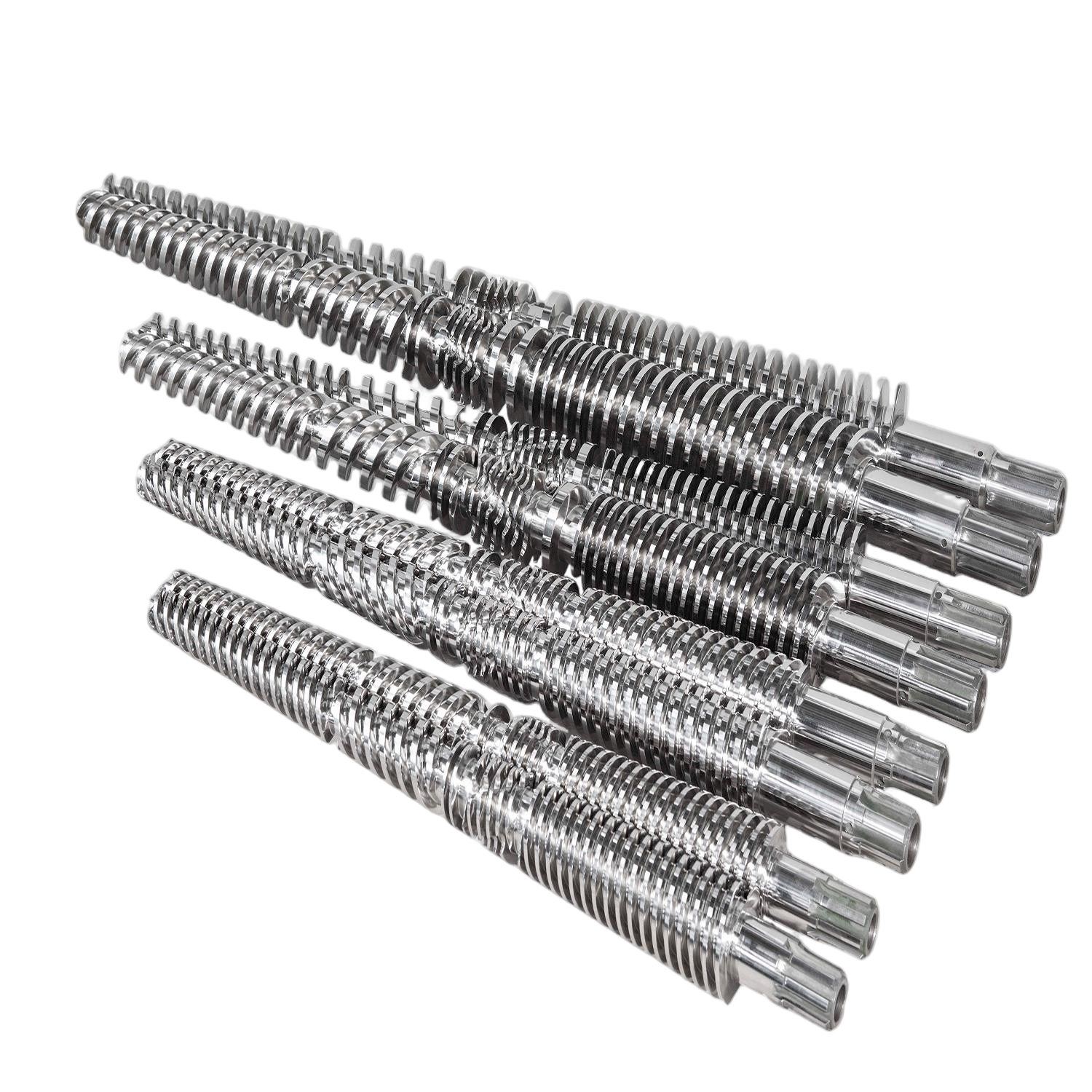
Parallel twin screw barrels (Φ45–Φ350) for compounding and pelletizing
The parallel twin screw barrel is classified as a compounding and pelletizing product with a diameter range of Φ45 to Φ350, serving the plastic recycling and compounding industries. Its documented service environment is high-wear and corrosive polymer processing, compounding, and extrusion or molding production.
Practically, this is the barrel family that carries formulations: filled and reinforced compounds, recycled streams with inconsistent contamination, and polymers that attack the metal surface. Compounding lines commonly use co-rotating intermeshing parallel screws, which give tighter control over shear, mixing and residence time across the barrel length — the reason the parallel geometry dominates formulation work rather than shaping work.
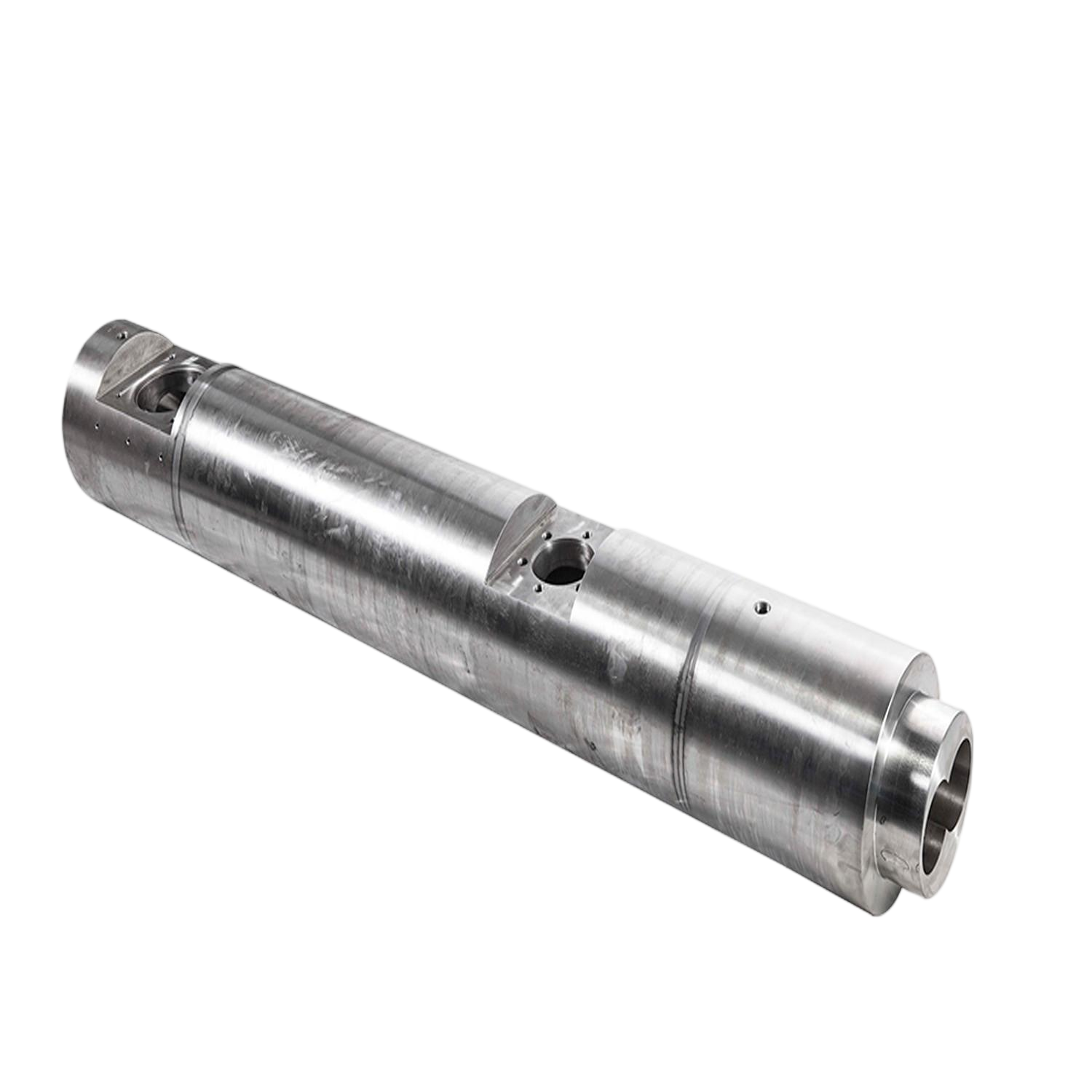
Shared metallurgy and quality specifications
Both barrel families are published against the same technical specification set, so a buyer can hold them to identical measurable criteria.
- Hardness after hardening & tempering: HB260–310
- Nitrided hardness: HV850–1000
- Nitrided case depth: 0.45–0.7 mm
- Nitrided brittleness: less than Grade 2
- Surface roughness: Ra 0.4
- Screw straightness: 0.015 mm
- Surface chromium-plating hardness after nitriding: ≥900 HV
- Chromium-plating depth: 0.025–0.10 mm
- Alloy (bimetallic) hardness: HRC50–65
- Alloy depth: 0.8–2.0 mm
Those numbers are worth placing next to external references. Industry-standard nitriding for a plasticating screw in 38CrMoAl (DIN 1.8509) is commonly quoted at a case depth of 0.4–0.6 mm with a surface hardness of 900–1,100 HV, and bimetallic barrels are typically described as carrying a centrifugally cast alloy liner of 1.5–3.0 mm. The published Guangyou specification sits inside those reference bands on nitriding and offers an alloy layer of 0.8–2.0 mm where bimetallic protection is specified — the exact layer and material to be confirmed per project.
Material selection runs across a broad menu, including 38CrMoAl (1.8509), D2, AISI316, 34CrAlNi7 (1.8550), DC53, AISI420, 31CrMoV9 (1.8519), Gr12MoV, 9Cr18MoV, 40CrNiMo, 440C, 17PH-4, 42CrMo, AISI304, Inconel 718, 40Cr, 1.2316, Hastelloy C-276, C45, 1.4462, Inconel 625, SKD11, 1.4404, Monel 400, SKD61, 1.4122, Monel 500 and S600. For a PVC blend carrying heavy CaCO3, corrosion-resistant grades such as AISI316 are the relevant conversation; for a highly loaded compounding stream, the harder tool steels or a bimetallic layer usually carry the wear duty.
Certifications and documentation behind each type
Both barrel families are produced under the manufacturer's ISO 9001:2015 quality management system and ISO 45001:2018 occupational health and safety management system. Quality control on production is documented as 100% test, which means every unit is inspected rather than sampled. For a PVC pipe extrusion project, that combination — a management-system certificate plus a full-inspection record — is the baseline; the certificate scope, the dimensional report and the material certificate for the specific heat are the documents that decide whether the barrel you receive matches the barrel you specified.
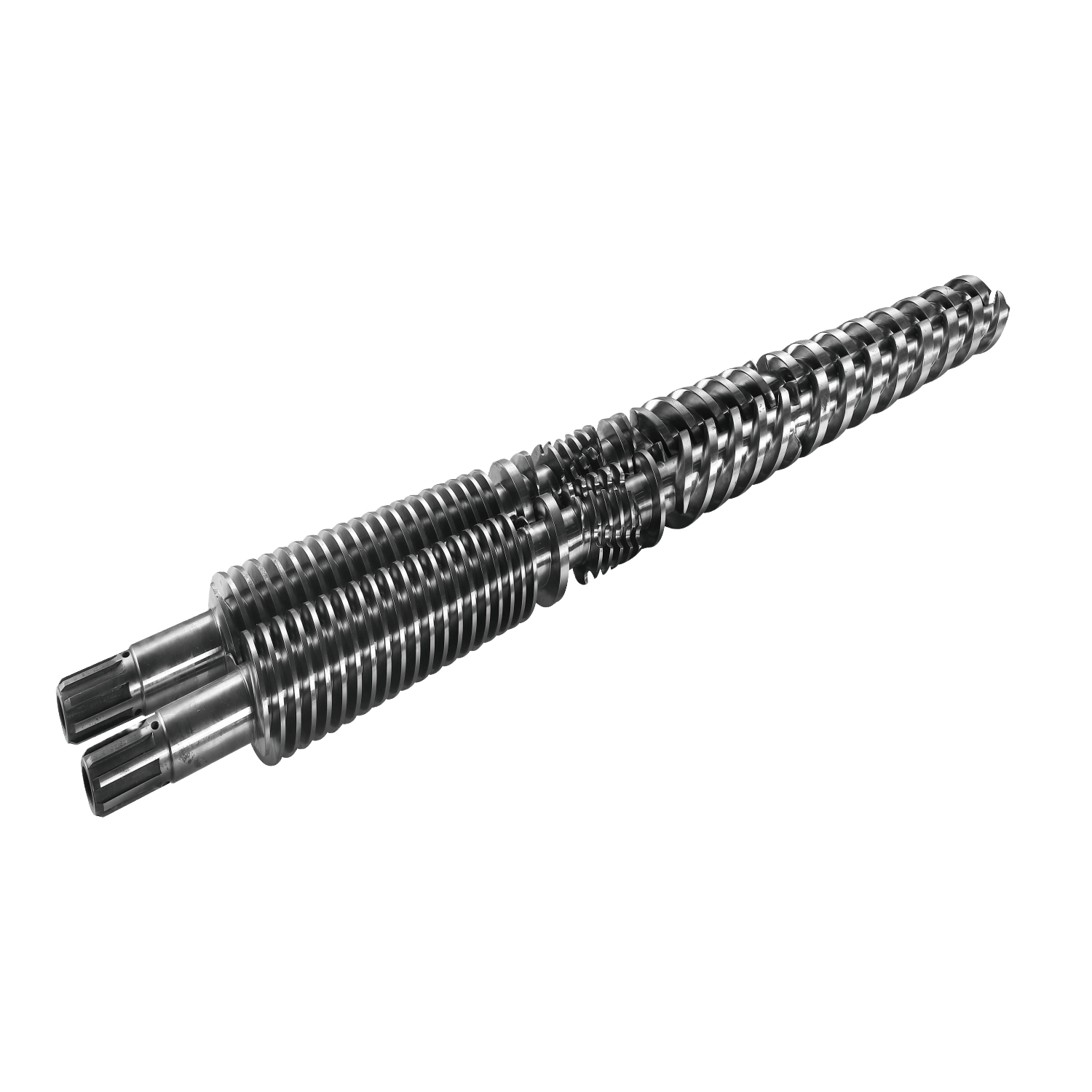
Step-by-Step: How to Match a Barrel Geometry to Your Line
The matching process is sequential. Skipping a step usually means re-opening the specification later, after the barrel has been quoted.
- Define the process, not the part. State whether the line melts PVC dry blend for pipe, profile or sheet, or compounds and pelletizes a formulation. Conical geometry belongs to the first; parallel geometry belongs to the second. Write down the target output and the filler or reinforcement loading at this stage, because it determines both geometry and metallurgy.
- Fix the geometry range. Compare your required size against the published ranges: Φ25/50–Φ185/340 for conical and Φ45–Φ350 for parallel. If your requirement falls outside the range of the geometry you had in mind, the question has already been answered.
- Confirm the machine interface. Verify outside diameter, centre distance, flange pattern, length-to-diameter ratio and feed opening against the existing screw set and extruder. For PVC work, confirm the barrel is intended for a PVC conical twin-screw extruder of matching specification.
- Select metallurgy against the wear and corrosion profile. Use nitriding where the duty is standard and the finish requirement is met by a nitrided surface; move to a bimetallic alloy layer where a high CaCO3 filler load or an abrasive compound is present. Choose the base material from the available steel menu according to corrosion exposure.
- Set the measurable acceptance criteria. Nitrided hardness HV850–1000; nitrided case depth 0.45–0.7 mm; nitrided brittleness below Grade 2; alloy hardness HRC50–65; alloy depth 0.8–2.0 mm; surface roughness Ra 0.4; straightness 0.015 mm. These are the numbers to put in the purchase specification and check on the inspection report.
- Validate documentation and commercial terms. Request ISO 9001:2015 and ISO 45001:2018 documentation with scope, confirm the 100% test regime, agree on OEM customization such as voltage and logo if the barrel is going into your own machine brand, and confirm the delivery plan against the published lead time for your size.
Published lead times help with that last step. For nitriding single screw and barrel, the quoted range is 40–50 days for Φ20–Φ90, 50–60 days for Φ90–Φ180, 60–70 days for Φ180–Φ250, and more than 70 days for larger sizes. Lead time varies with size and with whether a bimetallic version is specified, and monthly capacity stands at 2,700 units. Minimum order quantity is one unit.

Use Cases: Which Projects Take Which Barrel
High-filler PVC pipe, profile and sheet extrusion. This is the defining conical twin screw barrel scenario. The line runs continuous counter-rotating conical twin-screw extrusion on a PVC dry blend with heavy CaCO3 loading, matched with a PVC conical twin-screw extruder. The barrel must deliver efficient PVC powder melting, high-shear plasticizing and stable extrusion shaping under continuous air supply conditions, which is why high wear resistance, a bimetallic lining and a nitrided finish are all named as project requirements rather than options.
Compounding and pelletizing in plastic recycling. Here the parallel twin screw barrel works in high-wear and corrosive polymer processing, compounding, and extrusion or molding production. The specification priority shifts from product surface stability to wear and corrosion survival under mixed and contaminated feedstocks, which is the reason a bimetallic alloy layer and a harder base material are usually the first variables a compounder adjusts.
Machinery OEM assembly. Extrusion and injection machinery OEMs buy barrels as a component for a machine they will sell under their own name. The documented delivery requirement in this case is stable batch delivery with high dimensional consistency, so that machine assembly and commissioning proceed without fitting work on site. Batch customized component orders are documented from 1 to 50 pieces.
Replacement and local retrofitting. Distributors and service partners order against existing machines, sourcing a replacement barrel or a custom component from technical drawings. The documented outcome for this client type is a 100% precise mechanical fit on complex components manufactured to custom drawings — the critical measure when the barrel has to drop into an extruder already in service.
The application outcomes recorded for these client groups are consistent: enhanced wear and corrosion resistance, prolonged equipment service life, and minimized production downtime, with a service life of 1–5 years under normal high-filler PVC extrusion working conditions. That last figure is important for budgeting and for comparing offers. It is a conditional lifespan, not a warranty period — it assumes normal working conditions, correct screw pairing and a filler load within the barrel's specification.
Where each choice reaches its limit
A conical barrel is not the right answer for a formulation-heavy compounding line, where mixing control across the barrel length is the deciding requirement. A parallel barrel is not the automatic answer for a PVC dry-blend shaping line, where feed intake and gentle, consistent melting dominate. Where a plant runs both duties, the honest conclusion is usually two barrel specifications rather than one compromise. And in both cases, the barrel only performs to its target life if it is paired with a matching screw set and the correct process temperatures.
Parallel vs Conical Twin Screw Barrel: Specification Comparison
| Selection factor | Parallel twin screw barrel | Conical twin screw barrel |
|---|---|---|
| Model / size range | Φ45–Φ350 | Φ25/50–Φ185/340 |
| Process type | Compounding & Pelletizing | PVC Extrusion |
| Applicable industry | Plastic Recycling & Compounding | Plastics Machinery / Construction Materials |
| Core process role | High-wear and corrosive polymer processing, compounding, and extrusion/molding production | Efficient PVC powder melting, high-shear plasticizing, and stable extrusion shaping |
| Typical project | Compounding and pelletizing lines in plastic recycling | PVC pipe, profile, and sheet extrusion projects |
| Matched equipment | Compounding and pelletizing line configuration | PVC conical twin-screw extruders |
| Named project requirement | Wear and corrosion resistance for abrasive and chemically aggressive polymer streams | High wear resistance, bimetallic lining for CaCO3 high-filler processing, nitrided finish |
| Working condition | Continuous compounding and pelletizing production | Continuous counter-rotating conical twin-screw extrusion under continuous air supply |
| Hardness after hardening & tempering | HB260–310 | HB260–310 |
| Nitrided hardness / case depth | HV850–1000 / 0.45–0.7 mm | HV850–1000 / 0.45–0.7 mm |
| Alloy hardness / alloy depth | HRC50–65 / 0.8–2.0 mm | HRC50–65 / 0.8–2.0 mm |
| Surface roughness / straightness | Ra 0.4 / 0.015 mm | Ra 0.4 / 0.015 mm |
| Material options | 38CrMoAl (1.8509), D2, AISI316, 34CrAlNi7 (1.8550), DC53, AISI420, 31CrMoV9 (1.8519), Gr12MoV, 9Cr18MoV, 40CrNiMo, 440C, 17PH-4, 42CrMo, AISI304, Inconel 718, 40Cr, 1.2316, Hastelloy C-276, C45, 1.4462, Inconel 625, SKD11, 1.4404, Monel 400, SKD61, 1.4122, Monel 500, S600 | |
| Documented service life | 1–5 years under normal high-filler PVC extrusion working conditions | |
| Quality system / QC | ISO 9001:2015 and ISO 45001:2018; 100% test | |
| Order and customization | MOQ 1 unit; OEM production with voltage/logo customization; batch customized component orders from 1 to 50 pieces | |
FAQ
Screw barrel manufacturer for PVC pipe extrusion: what should I verify before I order?
Verify five things in order. First, geometry and size: a PVC pipe line takes a conical twin screw barrel in the Φ25/50–Φ185/340 range, matched with a PVC conical twin-screw extruder. Second, process requirements: the barrel should be specified for efficient PVC powder melting, high-shear plasticizing and stable extrusion shaping, with high wear resistance, a bimetallic lining for CaCO3 high-filler processing and a nitrided finish. Third, measurable quality parameters: nitrided hardness HV850–1000, nitrided case depth 0.45–0.7 mm, surface roughness Ra 0.4, screw straightness 0.015 mm, and alloy hardness HRC50–65 with alloy depth 0.8–2.0 mm where a bimetallic version is used. Fourth, documentation: ISO 9001:2015 quality management and ISO 45001:2018 occupational health and safety management, plus the 100% test record and the dimensional report for your unit. Fifth, commercial terms: MOQ is 1 unit, and lead time for nitriding single screw and barrel runs 40–50 days at Φ20–Φ90, 50–60 days at Φ90–Φ180, and 60–70 days at Φ180–Φ250, extending beyond 70 days for larger sizes.
Which barrel geometry fits a compounding or pelletizing line?
A parallel twin screw barrel in the Φ45–Φ350 range. It is classified for compounding and pelletizing and for the plastic recycling and compounding industries, and its documented duty is high-wear and corrosive polymer processing, compounding, and extrusion or molding production. The conical range is a PVC extrusion product line and its documented process role is PVC powder melting, high-shear plasticizing and stable extrusion shaping, which is a different job from dispersing fillers and additives in a formulation.
What drives the cost and the service life of a barrel?
Service life is documented at 1–5 years under normal high-filler PVC extrusion working conditions, and the recorded outcomes behind that figure are enhanced wear and corrosion resistance, prolonged equipment service life and minimized production downtime. Cost is driven mainly by size, geometry and metallurgy — whether the barrel is nitrided only or carries a bimetallic alloy layer, the alloy depth selected within the 0.8–2.0 mm range, the base material chosen from the available steel menu, and any OEM customization such as voltage or logo. Two identical-looking barrels quoted at different prices are normally not identical in those four variables, so compare them line by line before comparing totals.
Can I validate a barrel with a single unit or a small batch?
Yes. Minimum order quantity is one unit, and batch customized component orders are documented from 1 to 50 pieces, produced to custom technical drawings with a 100% precise mechanical fit and 100% test inspection. For a PVC extrusion project, the practical validation route is to order one barrel against your drawing, run it on the line, and check melt quality, output stability and surface finish against the specification before committing to a fleet-wide replacement schedule.
What lead time should I plan for, and how do I start?
Plan by size and metallurgy. Published lead times for nitriding single screw and barrel are 40–50 days for Φ20–Φ90, 50–60 days for Φ90–Φ180, 60–70 days for Φ180–Φ250, and over 70 days beyond that, with bimetallic status extending the schedule. Monthly capacity is 2,700 units, so batch OEM requirements can be scheduled in advance. To start a technical review, download the Guangyou Screw product catalogue or send your drawing and process data to info@gmscrew.com — WhatsApp +86 13858143949 is also available for a quick geometry and material pre-check.
Conclusion
The parallel versus conical decision resolves cleanly once the project is stated first. PVC pipe, profile and sheet extrusion takes a conical twin screw barrel in the Φ25/50–Φ185/340 range, built for counter-rotating conical extrusion of dry blend with high CaCO3 loading, with high wear resistance, a bimetallic lining and a nitrided finish as named project requirements. Compounding and pelletizing in plastic recycling takes a parallel twin screw barrel in the Φ45–Φ350 range, specified for high-wear and corrosive polymer processing. The shared specification set — HV850–1000 nitrided hardness, 0.45–0.7 mm nitrided case depth, HRC50–65 alloy hardness at 0.8–2.0 mm depth, Ra 0.4 roughness, 0.015 mm straightness, 1–5 years documented service life, ISO 9001:2015 and ISO 45001:2018 quality systems and 100% test — then gives you a common measuring standard so the choice is decided on fit rather than on claims.
Next step: match a barrel to your line
Send Guangyou Screw your extruder model, screw drawing and material system, and the team will confirm whether a conical or parallel twin screw barrel fits the project — including recommended material, nitrided or bimetallic configuration, and a delivery plan for your size.
en.gmscrew.com | Email: info@gmscrew.com | Tel: +86 13575629951 | WhatsApp: +86 13858143949 | Zhoushan, China
Have Questions or Need More Details?
Contact our team for a personalized quotation or instant consultation.
Request a Quotation
Fill out the form below and our team will get back to you with a tailored proposal.
WhatsApp Direct Chat
Prefer to chat in real-time? Message us on WhatsApp for instant assistance & quick answers.
- Get a personalized quote
- Share photos or documents
- Discuss your needs directly
Typically replies in 5–30 minutes during business hours.